Can’t tell a Mozart symphony from a Brahms one? In classical vs romantic music, the Classical style prizes clarity and balance, while Romantic music chases personal feeling, bigger sound and freer form.
This guide is part of our series on classical music periods.
| Item | Value |
|---|---|
| Classical period (approximate) | Around 1750 to 1820 |
| Romantic period (approximate) | Around 1800 to 1910 |
| Classical orchestra woodwinds and brass | No more than two of the same instrument per section |
| Beethoven’s Ninth premiere | 7 May 1824, Vienna |
| Chorus at an early Ninth performance | 80-100 singers |
Figures come from Wikipedia’s article on the transition and the Eastman School of Music’s Beethoven pages. Period dates vary between sources and figures can change, so check the source before you rely on them.
Classical vs romantic music: order versus emotion
Classical music was known for its clarity and regularity of structure, an elegant international musical style. Romantic composers kept many of those forms but wanted dramatic, openly emotional expression.
Think of Classical music as a well-proportioned conversation and Romantic music as a confession. Both are skilled, but they aim at different things.
- Classical: poise, symmetry, restraint, and tunes that are easy to follow.
- Romantic: intensity, colour, longing, nature, the supernatural and the individual artist.
According to Wikipedia, the Classical period of European art music lasted around 1750 to 1820, and Romantic music lasted around 1800 to 1910. The overlap is real, because styles did not switch off on a set date. If you want what came before, see our guide to baroque music characteristics.
How the sound differs
The two periods differ most in melody, harmony, form and mood.
- Melody: Classical tunes are short, symmetrical and singable. Romantic melodies stretch longer and lean on expressive peaks.
- Harmony: Classical harmony stays mostly within a home key and returns clearly. Romantic composers wander further and use richer, more surprising chords for colour.
- Form: Sonata form was the foundation for many Classical pieces and then for the new era. Romantic writers stretched it or replaced it with freer shapes.
- Mood: Classical works tend to balance contrasts. Romantic works often dwell on one extreme feeling.
Romanticism began in literature, with political roots, and later reached visual art and music. In music it set obvious, dramatic emotionalism against the simpler pieces of the Classical era.
Tempo and dynamics tell the same story. Classical performers usually kept to steady, well-judged speeds and moderate contrasts of loud and soft. Romantic players often pushed and pulled the beat, a habit musicians call rubato, and used sudden hushes or surges to heighten the drama.
Titles changed too. Classical composers mostly wrote abstract works named for their form, such as a symphony, a sonata or a quartet. Romantic composers more often added a story, a poem or a picture, so a piece might depict a landscape, a legend or a night scene.
Solo performers also took centre stage. The Romantic virtuoso, a pianist or violinist of dazzling skill, became a public celebrity, and the music written for them often showed off technique as well as feeling.
Use these contrasts as a rule of thumb, not a law. Plenty of Classical pieces are stormy, and plenty of Romantic ones are gentle.
Orchestra size and instruments
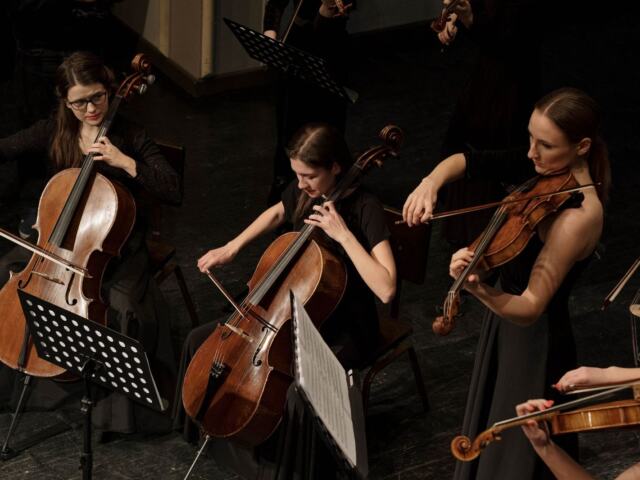
The Classical orchestra was considerably smaller than the modern symphony orchestra. It had fewer strings, no more than two of the same instrument in the woodwind and brass sections, and very few percussion instruments.
A typical Classical band, as one course text lists it, had flutes, oboes, clarinets, bassoons, horns and trumpets in pairs, plus timpani and strings. Beethoven’s later symphonies added piccolo, contrabassoon and trombones.
The Romantic orchestra kept growing, because new public concert halls accommodated bigger orchestras. More players meant more power and more tone colour.
Beethoven: the bridge between the two
Beethoven’s Ninth Symphony had its first performance on 7 May 1824 at the Kärtnerthor Theater in Vienna. The Eastman School of Music lists the orchestra size for an early performance as 80-100 in the chorus, with large forces of strings and winds.
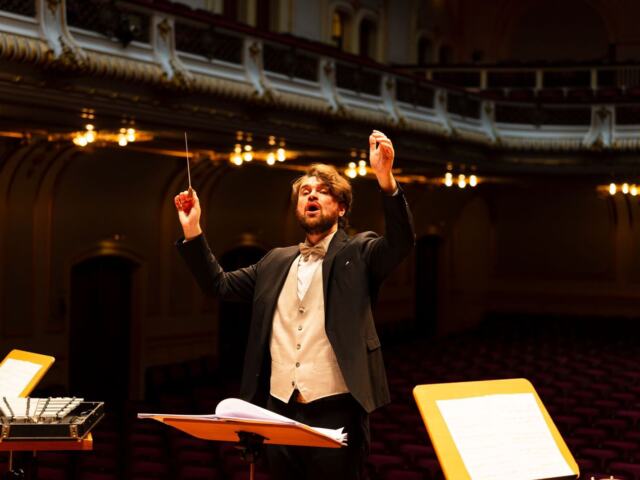
Adding a chorus and soloists to a symphony broke the Classical pattern of a purely instrumental work. It pointed the way to the ambitious, story-driven music later composers wrote.
To see how the symphony itself changed across both periods, read our history of the symphony.
Why the change happened
No single event ended the Classical era. Instead, taste moved gradually, and composers who grew up with one style found themselves writing in another by the end of their careers.
Music followed wider shifts in society. Classical music grew up in an age that admired reason, order and elegant manners, and much of it was written for courts, churches and patrons.
Romanticism valued the individual imagination. Artists began to be seen as inspired geniuses rather than skilled servants, and they wrote for a growing public who bought tickets to concerts in new halls.
That change also shaped what people listened for. A Classical audience enjoyed spotting how a composer handled a familiar form with wit and poise, while a Romantic audience wanted to be moved, startled or transported.
The Classical orchestra’s percussion section held only a very few instruments, so the growth of the orchestra in the Romantic era meant a real change in available sound.
National identity became another theme. Many Romantic composers drew on folk songs, dances and legends from their own countries, so the music could sound distinctly Russian, Czech, Polish or Norwegian. Classical music, by contrast, aimed at a shared international style.
Who to listen to, and how to hear the difference
Haydn and Mozart are the classic Classical voices, and Beethoven’s early works sit close to them. Schubert, Chopin, Schumann, Liszt, Brahms and Tchaikovsky are standard Romantic names.
- Classical starting points: a Haydn symphony or a Mozart piano concerto.
- Romantic starting points: a Chopin nocturne, a Schubert song or a Tchaikovsky symphony.
- Bridge pieces: late Beethoven, where Classical craft meets a much bigger emotional range.
Opera shows the same shift. Classical opera stressed elegant vocal lines and clear dramatic structure, while Romantic opera leaned toward intense passion, grand spectacle and richer orchestral colour.
- Listen to a Haydn or Mozart symphony and notice how easily you can hum the main theme and hear where each section ends.
- Then play a Romantic orchestral work and notice how the volume, speed and key shift more dramatically.
- Ask what the music is trying to do: show balanced craft, or express a mood or story?
Neither style is better. Each answers a different question about what music is for.
Frequently asked questions
Is Beethoven Classical or Romantic?
Show answer
Both. He built on Classical forms but pushed emotion and scale toward Romanticism, so he is usually described as a transitional figure.
Do the periods have exact dates?
Show answer
No. Wikipedia gives around 1750 to 1820 for the Classical period and around 1800 to 1910 for Romantic music, and the two overlap.
Which style uses a bigger orchestra?
Show answer
Romantic music. The Classical orchestra was considerably smaller than a modern symphony orchestra, and Romantic ensembles grew from there.
Does Romantic music break the Classical rules?
Show answer
Mostly it stretches them. Composers kept forms such as sonata form but treated them more freely to serve expression.