Lost among the names and dates? This famous classical composers timeline gives you anchor figures, from Monteverdi to Stravinsky, so any piece you hear has a place.
| Item | Key fact |
|---|---|
| Claudio Monteverdi | Baptized 15 May 1567; died 29 November 1643 |
| Wolfgang Amadeus Mozart | 27 January 1756 – 5 December 1791, aged 35 |
| Johann Sebastian Bach | German composer and musician of the late Baroque period |
| Igor Stravinsky | Russian composer and conductor |
These figures come from Wikipedia’s Monteverdi article and its Mozart article. Dates and spellings can change as scholars revise them, so check the sources before you rely on them.
The timeline below is a map, not a ranking. Many other composers worked between these names, and each name stands in for a larger shift in how music was written. Think of them as signposts on a long road rather than the whole road. For the labelled eras themselves, see our guide to classical music periods.
How to read a composer timeline
A timeline of composers works best when you treat each life as a window onto a style. Composers did not wake up one morning and start a new era; they learned from teachers, borrowed from rivals and pushed a little further.
Two cautions help. First, some dates are uncertain: Monteverdi and Beethoven are recorded by baptism rather than birth. Second, calendars differ: Bach’s birthday of 21 March 1685 is given in the Old Style (Julian) calendar, so the modern-calendar date differs.
- Early Baroque: Monteverdi, opera takes shape.
- Late Baroque: Bach, counterpoint and vast sacred and instrumental output.
- Classical: Mozart, balance, clarity and operatic drama.
- Classical into Romantic: Beethoven, personal expression on a huge scale.
- Modern: Stravinsky, rhythm that broke old habits.
Monteverdi: opera finds its voice (1567-1643)
Claudio Monteverdi was baptized on 15 May 1567 and died on 29 November 1643. Wikipedia describes him as an Italian composer, choirmaster and string player.
His late career overlapped with a landmark for the art form. The opening of the San Cassiano opera house in 1637 was the first public opera house in Europe, and Monteverdi wrote for the commercial stage in his final years. His opera L’incoronazione di Poppea (The Coronation of Poppea) dates from 1643, the year he died.
If you want to hear what separates his sound world from later music, the baroque music characteristics are a good place to start, since he stands at the doorway of that style.
Bach: the summit of the Baroque (1685-1750)
Johann Sebastian Bach was born in Eisenach and died on 28 July 1750. Wikipedia calls him a German composer and musician of the late Baroque period.
His fame grew after his death. According to the same article, since the 19th-century Bach Revival he has been widely regarded as one of the greatest composers in the history of Western music. Reputation, in other words, can keep growing long after a composer’s lifetime ends.
Bach died on 28 July 1750 from complications due to unsuccessful eye surgery, according to the same article.
Mozart and Beethoven: the Classical turn (1756-1827)
Wolfgang Amadeus Mozart was born in Salzburg on 27 January 1756 and died in Vienna on 5 December 1791, aged 35. Wikipedia describes him as a Classical composer.
Ludwig van Beethoven was baptized in Bonn on 17 December 1770. He died on 26 March 1827, aged 56, and Wikipedia notes that his late period (1812-1827) included some of his most innovative works.
One landmark stands out: his Missa solemnis and his final symphony, the Ninth, premiered in 1824. Beethoven is often placed at the hinge between the Classical and Romantic periods, taking the forms Mozart polished and stretching them toward personal drama.
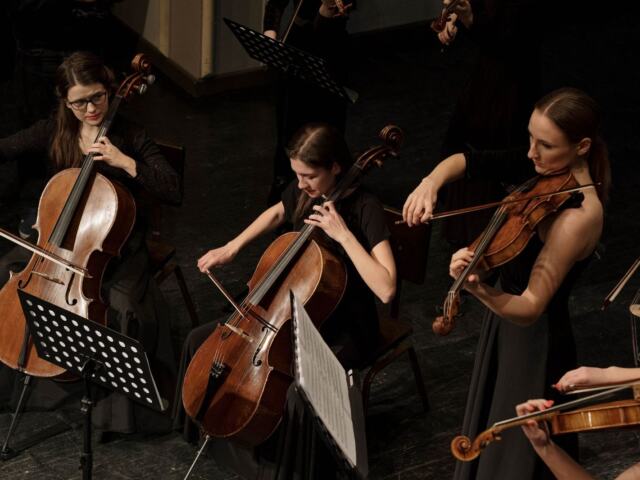
Chamber music was a testing ground for both men. If you are curious how a quartet of players shares a musical argument, the explainer on what is a string quartet shows how the genre works.
Stravinsky: breaking the rules in the modern age (1882-1971)
Igor Stravinsky was born on 17 June 1882 in Oranienbaum, Russia, and died in New York City on 6 April 1971. He was a Russian composer and conductor who later took French (from 1934) and American (from 1945) citizenship.
His breakthrough came through the Ballets Russes in Paris, with three ballets commissioned by the impresario Sergei Diaghilev: The Firebird (1910), Petrushka (1911) and The Rite of Spring (1913). Wikipedia says the last caused a near-riot at its premiere and later changed how composers understood rhythmic structure.
That arc, from Monteverdi’s early opera to Stravinsky’s ballet, spans a long stretch of Western concert and stage music, and each composer in this list was reacting to those who came before.
Notice how the gaps between names tell a story too. Monteverdi and Bach are separated by decades in which opera, church music and instrumental writing all matured. Bach and Mozart are separated by a change of taste, away from dense interwoven lines and toward tuneful, clearly phrased music.
Beethoven and Stravinsky are separated by the largest leap of all. Between them, composers explored bigger orchestras, national styles and new ideas about harmony, and Stravinsky arrived at a moment when rhythm itself was ready to be rethought.
Using the timeline when you listen
You can use these five lives as a listening plan. Start with one work by each composer, then ask what changed: the size of the ensemble, the role of rhythm, or how personal the music feels.
- Pick a piece by Monteverdi, and notice how voices carry the drama.
- Move to Bach, and follow how several melodic lines run at once.
- Listen to Mozart, and hear balanced, clear phrases.
- Try Beethoven’s Ninth, and notice the growth in scale.
- Finish with The Rite of Spring, and feel the rhythm drive everything.
Add other composers around these anchors as your ear develops. A timeline is only a starting frame, and the best way to fill it in is by listening.
Keep a simple notebook as you go. Write the composer, the year of the piece, and one sentence on how it feels compared with the last one you heard. Over time, the notebook becomes a personal record of how the music changes from one composer to the next.
It also helps to listen to live or recorded performances with the score or a short programme note beside you. Programme notes often explain why a piece was written, who commissioned it and how audiences first reacted, which is exactly the sort of context a timeline can only hint at.
Frequently asked questions
Who is the earliest composer in this timeline?
Show answer
Claudio Monteverdi, baptized on 15 May 1567. He is the earliest of the five composers covered here, though music history stretches much further back.
Why are some composers listed by baptism date?
Show answer
For some composers, such as Monteverdi and Beethoven, the surviving record is of baptism rather than birth. Wikipedia lists Beethoven’s baptism as 17 December 1770.
Did Mozart or Beethoven live longer?
Show answer
Beethoven. Mozart died aged 35 in 1791, while Beethoven died aged 56 in 1827.
Which composer on this list is the most recent?
Show answer
Igor Stravinsky, who died in New York on 6 April 1971. His ballet The Rite of Spring premiered in 1913.